
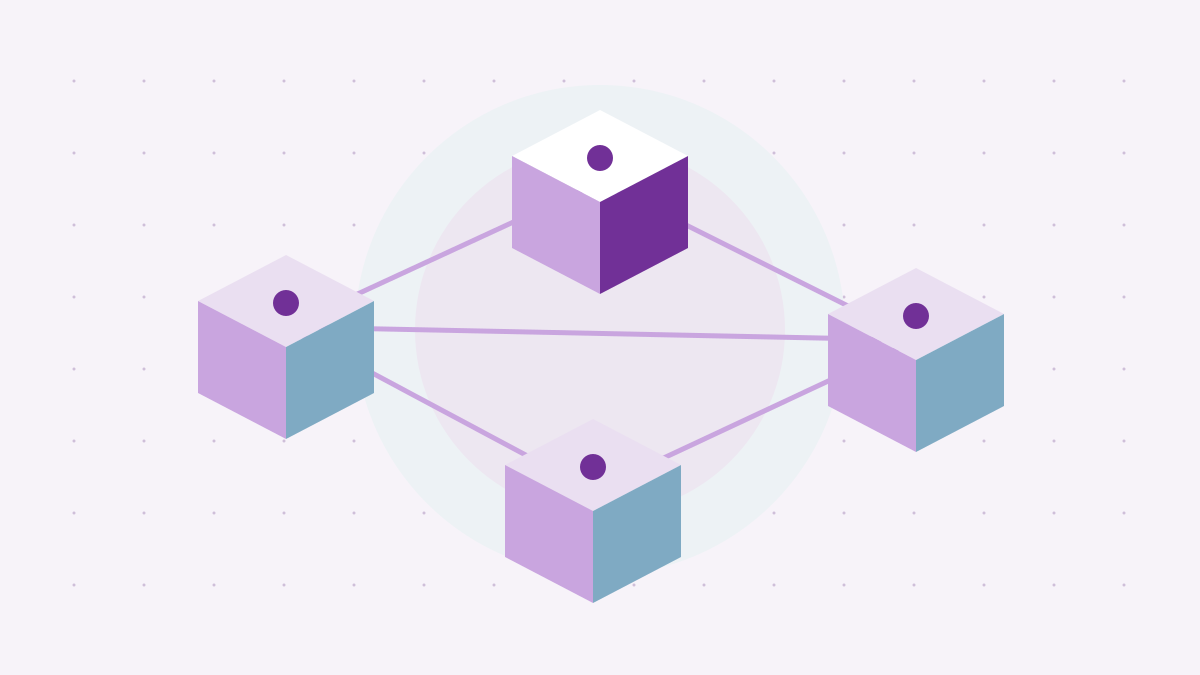
Consider a small community archive that records changes to a shared catalog. This guide uses that context to distinguish the consistency of a record from the accuracy of the information first entered into it.
What blockchain security means
Blockchain security concerns the conditions under which a shared record can be accepted, checked, and maintained. A useful starting point is to separate the record from the software displaying it and the people supplying its information. These parts work together, but they answer different questions. A reliable record does not automatically make every sentence written into it accurate, every application well designed, or every participant identifiable.
The term ブロックチェーン セキュリティ describes the same broad subject in Japanese. This English guide approaches it through records, permissions, and evidence. No practical experiment with a wallet is needed to understand the explanations. The examples use imaginary publishing and archive situations, so readers can concentrate on what a system demonstrates and what remains an assumption.
The illustration begins with this setting: A small community archive that records changes to a shared catalog. Imagine an archive in Istanbul sharing a catalog with readers elsewhere. Its central question is simple: when two people consult the catalog, how can they establish that they are discussing the same edition? Blockchain provides one possible set of mechanisms for that question. Whether it is appropriate depends on the archive's actual needs.
A shared record, its blocks, and its boundaries
A blockchain arranges records into blocks and connects those blocks using cryptographic references. Participants maintain copies according to agreed rules. The National Institute of Standards and Technology describes this combination in terms of records that reveal later alterations and resist changes under the network's operating assumptions. Those careful descriptions are more useful than treating the word permanent as an unlimited promise.
For the imaginary archive, each catalog edition might contain a list of document identifiers. An edition can refer to the preceding edition, allowing readers to inspect the order. The archive still needs a way to establish who submitted each identifier, which changes are allowed, and how participants agree on the accepted history. A chain of references by itself does not settle those questions.
The boundary of the record also matters. The catalog might contain a document's fingerprint while the document itself remains elsewhere. Preserving the fingerprint does not preserve the document. A reader who has only a catalog entry cannot necessarily reconstruct the original material. When evaluating a description of blockchain storage, distinguish the information recorded directly from information merely referred to.
Hashes establish correspondence between exact data
A cryptographic hash is a fixed-length result calculated from input data. The same calculation on identical input gives the same result. Suitable hash functions make it computationally difficult to find different inputs with a chosen matching result. A small change to a document normally produces a very different hash, making hashes useful when checking whether two copies contain identical bytes.
Consider two versions of a catalog entry. One says a manuscript contains twelve pages; the other says thirteen. Their fingerprints will differ even if the page design looks identical. Conversely, matching fingerprints can establish correspondence between copies without establishing whether the manuscript actually contains the stated number of pages. That factual question requires evidence about the manuscript itself.
Even invisible differences matter. A changed line ending, an additional space, or a different file encoding can change a document's bytes. An accurate educational example therefore specifies what is being compared. Comparing a scanned page, the text transcribed from it, and a compressed copy are three different comparisons. A mismatch identifies a difference; it does not explain its cause.
Hashes also differ from encryption. A fingerprint is not a locked copy of the original document waiting to be opened. This distinction prevents a common misunderstanding: placing a hash on a public record does not make the underlying information private, and hashing a predictable piece of information may still permit comparison against possible inputs.
Signatures, keys, and identity
Digital signatures connect a message to a cryptographic signing capability. In a common account model, a private key produces a signature and public information allows others to verify it. The signature is associated with the signed data, so the wording of the message matters. An Ethereum account and the wallet application used to interact with it are distinct concepts.
A signature does not, on its own, identify a person's legal name, qualifications, or institutional role. In the archive example, a signature might demonstrate that the key assigned to an editor authorized a catalog update. Establishing that the key actually belongs to the editor requires an additional identity process. Establishing that the editor was entitled to make that particular change requires an additional permission rule.
It is useful to write three separate statements when reading a claim: this message has a valid signature; this key is associated with this person; this person holds this permission. Each statement needs its own evidence. Combining them into a single sentence about a verified person can conceal what was actually checked.
Public identifiers belong in a different category from confidential signing material. A public address identifies a network location or account context; a private key enables actions in the relevant cryptographic system. Neither document names nor friendly account labels change that distinction. This article uses no real addresses or example secret phrases because the reasoning does not require them.
Validation and consensus solve different problems
Validation checks whether a proposed record follows the rules. Consensus concerns how participating computers coordinate around an accepted history. In Ethereum, node software checks network data, while the proof-of-stake mechanism coordinates block proposals and attestations. These descriptions concern Ethereum specifically; other blockchains can use different participation and agreement mechanisms.
Imagine three archive branches receiving two catalog updates in different orders. Both updates might be individually well formed. The branches still need a shared ordering rule, especially when a later update depends on an earlier one. Agreement on order gives everyone a consistent basis for interpreting the catalog. It does not transform an inaccurate submission into an accurate description of a manuscript.
Participation models also differ. A permissioned network restricts specified activities to authorized participants. A permissionless network allows participation under its public protocol conditions without individual admission by a central administrator. Read access, submission rights, and block production rights can differ within one design. The labels public and private are therefore incomplete without an explanation of the particular activity.
Decentralization is most informative when attached to a concrete question. Who operates the nodes? Who maintains the software? Who can change an application? Who supplies outside information? A system can distribute one responsibility widely while concentrating another. Counting copies of a record provides only one part of that description.
From a proposed change to a recorded outcome
A blockchain transaction is an instruction interpreted under a network's rules. In Ethereum, signed transactions can request changes to network state. Submission, inclusion in a block, execution, and finality are related stages, with different meanings. A message saying that a request was received does not establish that every later stage has completed.
For the archive, imagine a request to replace an old catalog reference with a corrected one. A receiving computer might acknowledge the request before the shared catalog changes. A later record might show that the request was included but did not achieve the intended application result. Reading an outcome accurately requires both the network status and the relevant application meaning.
Finality describes the conditions under which a recorded history is treated as settled by a particular protocol. Ethereum uses checkpoint agreement in its proof-of-stake system. Other designs may describe confidence differently. A universal waiting time cannot be inferred from the word blockchain, and a displayed confirmation count is meaningful only in the context of its network.
The distinction between a record and its interpretation applies to timestamps as well. A block timestamp is part of a network record. A document's creation time, an editor's submission time, and the time a reader's screen refreshes are separate events. A careful explanation labels each time instead of treating them as interchangeable proof of when something happened in the world.
Smart contracts and application rules
A smart contract is a program executed within a blockchain environment. It can define conditions for changing stored information and responding to transactions. The term smart does not mean the program understands human intentions. Its behavior depends on its code, input, surrounding state, and any other components on which it relies.
In a fictional catalog, a contract could permit an update only when two authorized editors have approved it. That rule could be checked consistently by the network. The program would still need a precise representation of an editor, an approval, and an update. If the intended editorial process has exceptions that were never represented, the program cannot infer those exceptions from ordinary language.
Application security also includes control over changes. Some systems have upgrade mechanisms or administrative permissions. Others have fewer ways to alter deployed behavior. A reader should distinguish the code currently in use from the process that can replace or influence it. The existence of public code provides material for examination; it is not a complete assessment.
Testing and independent code assessment have defined scopes. A report may examine one version, selected components, and specified assumptions. It cannot establish that every later modification or connected application has been examined. The useful reading task is to identify what the evidence covers, when it applies, and which questions it leaves open.
When a blockchain depends on the outside world
Ethereum smart contracts cannot independently retrieve arbitrary information from outside their execution environment. An oracle is a mechanism that brings outside information into a form a contract can use. The network can agree that a particular value was submitted while the accuracy and timeliness of that value remain separate questions.
Suppose the catalog includes the temperature of a manuscript storage room. The recorded number depends on a sensor, its location, its calibration, the collection process, and the time of measurement. A correctly preserved number could still describe the wrong room. A complete explanation follows the information from the physical observation to the final record.
Multiple reports can provide more context, but independence matters. Three reports copied from one sensor are different from measurements made by three independent sensors. Agreement alone does not reveal whether the reports share a common source. This is an example of how understanding information provenance improves interpretation without requiring a technical prediction.
The same reasoning applies to digital certificates, event records, and supply information. A blockchain can preserve a claim and the context supplied with it. Readers still need to understand who made the claim, what was measured, and which methods connect the record to its subject.
Public visibility and personal information
Public blockchain data is generally available for inspection. Pseudonymous addresses do not automatically conceal relationships between activities. A person may associate an address with a public profile or reveal additional context through ordinary application use. Privacy therefore depends on more than whether a legal name appears directly in a record.
For the archive, publishing a contributor's identifier could become more revealing when combined with a separate list of workshop participants. Each list might seem limited on its own. Together they can establish a connection that neither list explicitly states. This thought experiment illustrates why the purpose and audience of a record matter before information is made widely visible.
There is also a distinction between information on the blockchain and information involved in reaching it. An application can communicate with network infrastructure to request data. Those communications have their own metadata and processing arrangements. A statement about public ledger transparency does not describe every data practice of the application displaying that ledger.
Privacy technologies can introduce selective disclosure or other forms of confidentiality, but their properties are specific to their construction and use. The name of a technique is only the beginning of an explanation. The informative questions concern what is revealed, to whom, under which assumptions, and at which stage.
Match each claim to the evidence it needs
| Claim | Relevant evidence | Remaining question |
|---|---|---|
| Two documents match | A comparison of their exact bytes or cryptographic fingerprints | Are the documents accurate? |
| A key signed a message | A valid signature for the stated message | How is the key associated with a person? |
| A record is accepted | The appropriate network and its accepted history | What does the application outcome mean? |
| An outside observation is correct | Information about the source and collection method | Was the observation current and relevant? |
| A program was examined | A report identifying version, scope, and methods | Do those boundaries match the present system? |
This comparison is a reading aid. It is not a scorecard for declaring a product suitable. Its purpose is to keep a conclusion proportional to the evidence presented. The most useful answer may be that a particular fact has been established while another remains unspecified.
Three exercises for a more precise understanding
First, write a one-sentence description of the imaginary archive's purpose without using blockchain terminology. For example, the archive wants readers to compare catalog editions and attribute changes to designated editors. Then identify which parts require shared records, identity evidence, and editorial judgment. This separates the actual need from any proposed technology.
Second, describe a catalog update at three levels: the request that was made, the record the network accepted, and the meaning a reader assigns to it. If your descriptions are identical, consider whether you have omitted an application rule or a stage of processing. Clear distinctions make later technical reading easier.
Third, take the statement that a record is verified and finish the sentence: verified for what, by whom, using which information? Several different answers may be valid. A cryptographic comparison, a network rule check, and a human review can all involve verification while establishing different things.
These exercises are complete with paper and ordinary reasoning. A beginner's progress can be measured by the ability to explain boundaries, use terms consistently, and recognize missing context. The result is a foundation for reading about distributed systems, digital identity, information provenance, and applications across many subjects.
Reference notes
The technical background draws on NIST's Blockchain Technology Overview and Blockchain; and Ethereum documentation titled Ethereum accounts, Transactions, Blocks, Nodes and clients, Proof-of-stake, Introduction to smart contracts, Smart contract security, Oracles, and Privacy on Ethereum. The archive examples and learning exercises are original explanatory illustrations. They describe no actual deployment, product examination, or institutional relationship.